
The Seagull
by Anton Chekhov
Synopsis
The research on The Seagull by Anton Chekhov includes an introductory workshop and a video analysis of a pivotal scene which — in the Theatro Tarot version — functions as a turning point for how the story might evolve beyond conventional realist patterns.
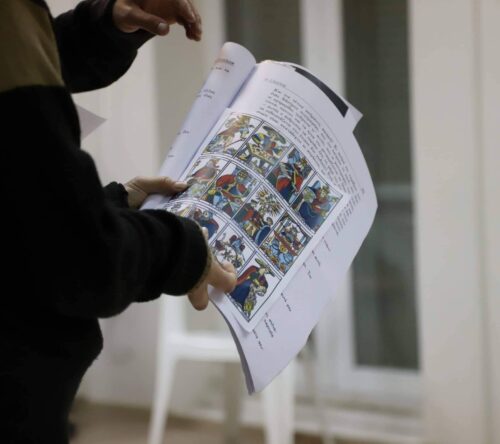
The workshop took place at the Lefkada Cultural Center and lasted approximately fifteen hours over the course of one month (February 2019). The research focused exclusively on the Major Arcana of the Tarot of Marseilles. The central question that concerned us was the following:
how can the archetypes of the Tarot — these primordial images connected to dreamlike states and inner psychic processes — enter into dialogue with one of the most important works of the world repertoire, such as The Seagull, a play that has primarily been approached through a realist perspective?
So far, the research has not expanded into a full version of the play. The workshop focused mainly on improvisations aimed at creating archetypal images influenced by the language of Tarot. Images capable of expressing the familial, emotional, and erotic relationships between the characters.
Among the relationships explored were:
Arkadina’s relationship with her son Treplev and her brother Sorin; Shamrayev’s relationship with his wife Polina and their daughter Masha; Nina, caught between her love for Treplev and her relationship with Trigorin, who is simultaneously Arkadina’s companion; as well as the relationships between Doctor Dorn and Polina, Medvedenko and Masha, and the worker Yakov.
The Seagull is, of course, an exceptionally rich play that delves into the psychological composition of the characters and the complex patterns of their relationships. Improvising on this material while at the same time guided by the archetypal language of Tarot allowed us to even “see” and work on characters who do not explicitly appear in the play, such as Nina’s parents.
As an additional tool, the genogram was used to map the dominant emotional dynamics between the characters. This diagram functioned as a main point for the physical representation of relationships, allowing the group to move away from psychological realism and toward a symbolic, physical language.
For example: Treplev physically bound to his mother as if by an umbilical cord, or Nina suffocating within her relationship with her father. These physical images became the central axis of improvisations.
Within the framework of the workshop, these explorations strengthened the belief that The Seagull could fully develop in such a direction: not merely through fragmented directorial ideas, but as a complete dramaturgical and scenic language.