
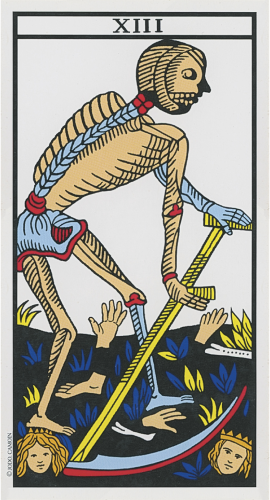
At the heart of the book lies the Nameless Card of the Tarot of Marseilles. The card without a name, which in other Tarot decks is called DEATH! The Tarot of Marseilles very wisely leaves it unnamed, as an invitation — or provocation — to set aside our prejudices, because it does not symbolize physical death. On the contrary, it symbolizes concepts such as transformation, liberation from the “old,” and the birth of a new pattern. Around this archetypal axis unfolds the reading of the two emblematic theatrical works.

The first stage of the ritual is approached through an important detail of the card: the two heads lying on the ground, literally or symbolically separated from their bodies.
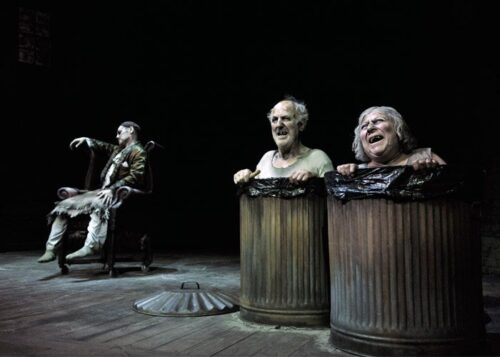
In Beckett’s play, Hamm’s parents appear only up to their heads, emerging from trash bins. Two bodies trapped in immobility and decay. Hamm himself is also immobilized in his wheelchair and blind. The ritualistic-healing process concerns Clov. Likewise, in Sophocles’ work, Oedipus — unknowingly — murders his father and unites with his mother, who ultimately takes her own life under the unbearable weight of truth and revelation.
No useless element is tolerated (parents inside trash bins), but also parental models that must be “killed” (patricide and the mother’s suicide) so that a new model may be born. In both works, the parental figure has been severed — literally or psychologically.
Let us now focus on the central figure: the skeleton, the “Reaper,” the “Death” figure. In both works, this “skeleton” is the blind king. For Clov, it is Hamm. Within Beckett’s play itself, therefore, there exists a character who stares directly at his own “death” through the form and story of another character, to finally rid himself of the garbage/traumas of his life.

For Oedipus, the “skeleton-blind king” he confronts is, of course, his own self. This is precisely why the stage depiction after the blinding becomes so compelling.
This is the moment when Tarot Theatre allows darkness to flood the theatrical space. Because it is in darkness that Oedipus encounters his trauma. The new form that emerges from the darkness is a more complete Self, whose fragmented parts had been waiting to be integrated. When this integration begins, what occurs is not simply “healing” in the sense of eliminating pain, but something deeper: transformation.
Conceptually, this is the moment when Oedipus transforms into the Prodigal Son (based on Massimo Recalcati’s analysis in The Secret of the Child), who simultaneously became a central symbol in Dalí’s Tarot (used in Tarot Theatre’s version of Oedipus).
We see Oedipus confronting his blind self at the exact moment when he is embraced by his parents. They cease to be the parents who, because of a prophecy, decided to kill him while he was still an infant. He confronts the “skeleton-blind king” to experience acceptance and reconciliation.
These are concepts that also exist within the central figure of the Nameless Card itself. If we look carefully, we notice that it is not exactly a skeleton. It is not merely bones — what remains after life has departed. It has a skin and organic life. Furthermore, its spine is blue (a sign of spiritual work), and on its garment appears a small blue heart. Details that may help us delve deeper into this “terrifying figure,” into the symbolism of the card, rather than remaining trapped in the initial fear it provokes. Just as the skeleton has a body, the “blind” King Oedipus ultimately has eyes and truly sees.
In both plays, the parents function as a signifier connected to dead perceptions that we are called upon to throw away like garbage. As two heads that will be “separated” from their bodies, buried in the earth so that one may step upon them, cultivate the soil, and allow a new dynamic — new perceptions — to grow. The skeleton, correspondingly, symbolizes the fears and guilt that arise when we perform this violent act. Yet ultimately it has a body, it has a heart. Clov is right to separate himself from his deadened environment. Oedipus is right to destroy poisonous patterns and obsolete beliefs.
We also understand that within the completion of this ritual lies acceptance and reconciliation. Love is contained within it — a love that was not visible at first because of the violence involved. Tarot Theatre’s version of Sophocles’ work also reveals another dimension of the play’s value. The embrace between the redeemed Oedipus and his parents introduces the new parental model that emerges to replace the old one. The book, therefore, is based on two plays, but it ultimately concludes with the ending created in Tarot Theatre’s version of Oedipus.
Tarot Theatre depicts healing through the transformation of a myth. It searches for the different archetypes — or, in this article, the one archetype — that can contribute to another perspective on tragedy. The connection between the Nameless Card and the two plays also functions as a ritual connective tool.
In this research, the scythe cuts away whatever is no longer alive within us. Oedipus and Clov meet at the end of a paternal era that must be buried so that a new one may emerge. Clov frees himself from the garbage of his life, from the useless parental model, and liberates himself from the blind and immobilized, decaying self (Hamm) trapped within four walls. Oedipus confronts his blind king-Self for the final time to reconnect with his reborn parents and rediscover love.
Through all the above analysis, the significance of the “anonymity” of this Tarot card is ultimately revealed. We do not complete our psychic journey with death — especially not in the archetypal world of Tarot and Art. Stage thirteen (13) is none other than transformation. If there is something we must bury, it is our prejudices and our dead beliefs. Even those concerning Theatre itself…